
The Slow Pace of Mexico's Labor Market Recovery After COVID-19
Downloads
Abstract
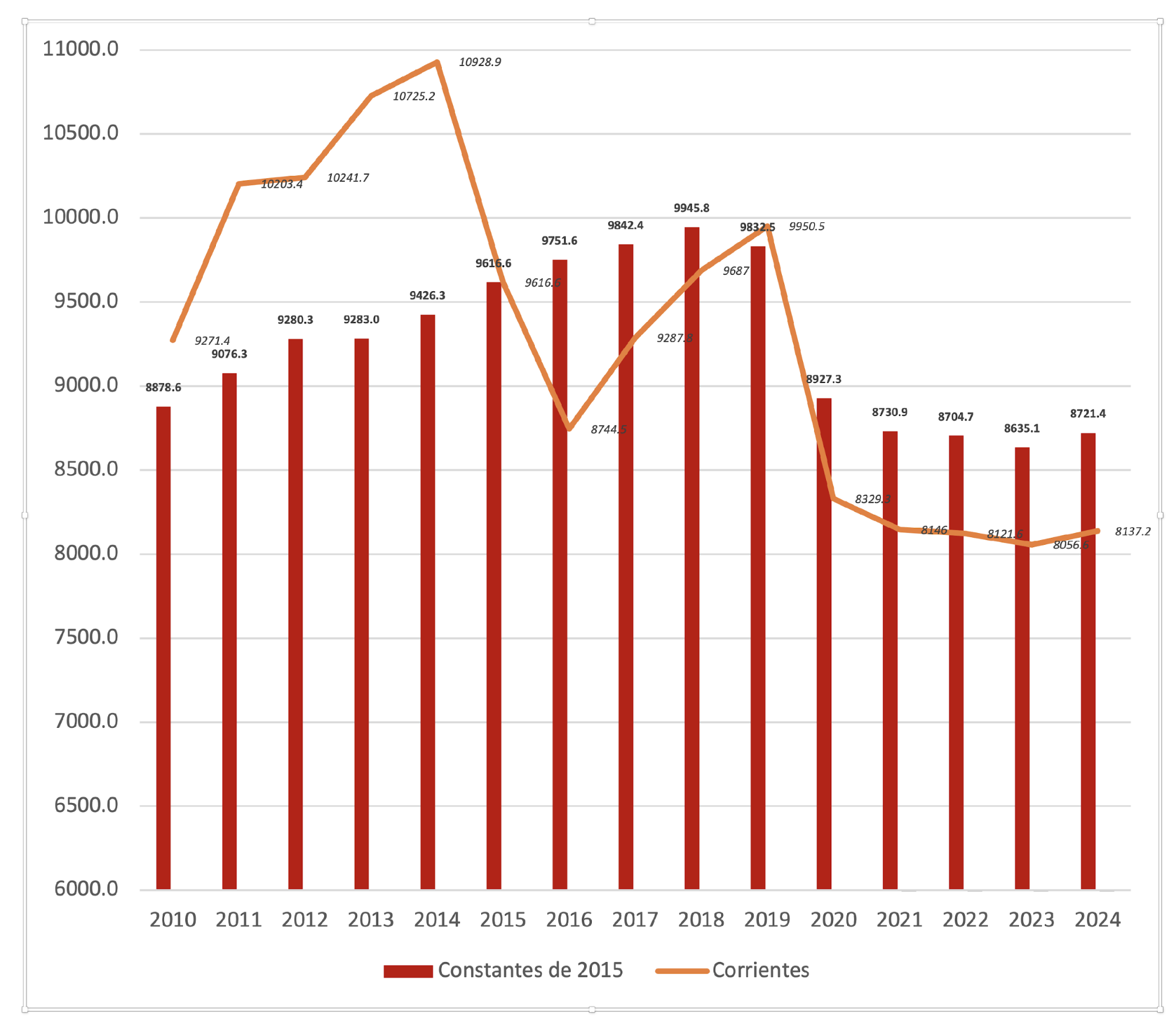
This document aims to assess the recovery of Mexico's labour market following the COVID-19 pandemic. In 2020, the country experienced a significant decline in gross domestic product, the most severe since the crisis of 1982, which also had a profound impact on labor market conditions. The economy was heavily reliant on oil exports, and the country faced challenges due to low oil prices and a sharp increase in international interest rates, as it was one of the most indebted countries globally. The analysis in the document relies solely on official data and employs comparative statistical methods. The hypothesis posits that four years after the 2020 crisis, Mexico's per capita GDP and most labor market indicators have not fully recovered to pre-pandemic levels. While the potential for recovery exists, various factors, including government actions and external conditions, have significantly altered the landscape. Internally, Mexico has implemented a range of social programs aimed at boosting basic incomes, albeit at the expense of capital investment and human capital development, particularly in education, training, health, capacity building, and science and technology. Externally, barriers to free trade and foreign investment have been erected, clouding Mexico's short-term economic outlook.DOI:
https://doi.org/10.63942/brjssh.v5.i10.p25.9773Keywords:
Covid-19, economic growth, labor market, minimum wages, social programsIntroduction audio
A spoken introduction to this research.
Research ID
Universal Unique Research ID
5c8e081c-1c9e-40aa-bb97-9773a5c5706dFigures
Select a figure to view the full image.
References
CONASAMI (Minimum Wages National Commission). (2025). *Minimum general and professional wages by area and year tables*. [https://www.gob.mx/](https://www.gob.mx/)
CONAST (National Conference of Secretaries of Labor). (2014, August 28). *CONAGO*. www.conago.org.mx
CONEVAL (National Council for the Evaluation of Social Development Policy). (2022). *Evolution of income poverty lines*. [https://www.coneval.org.mx/Medicion/MP/Paginas/Lineas-de-Pobreza-por-Ingresos.aspx](https://www.coneval.org.mx/Medicion/MP/Paginas/Lineas-de-Pobreza-por-Ingresos.aspx)
CONEVAL (National Council for the Evaluation of Social Development Policy). (2023). *CONEVAL presents information on working poverty for the fourth quarter of 2022*. [https://www.coneval.org.mx/Medicion/Paginas/ITLP-IS_pobreza_laboral.aspx](https://www.coneval.org.mx/Medicion/Paginas/ITLP-IS_pobreza_laboral.aspx)
DOF (Official Federation Diary). (2012, November 30). *Federal Labor Law*.
GCDMX (Government of the City of Mexico). (2014, August). *Política de recuperación en México y en el Distrito Federal del salario mínimo. Propuesta para acuerdo*.
ILO (International Labor Organization). (2015). *Global wage report 2014/15: Wages and income inequality*.
IMSS (National Institute of Social Security). (n.d.). *Historical waged workers information*. Ministry of Labor and Social Prevision. [https://www.stps.gob.mx/gobmx/estadisticas/asegurados.htm](https://www.stps.gob.mx/gobmx/estadisticas/asegurados.htm)
INEGI (National Institute of Statistics and Geography). (2024a). *National index of consumer prices (INPC)*. [https://www.inegi.org.mx/temas/inpc/#tabulados](https://www.inegi.org.mx/temas/inpc/#tabulados)
INEGI (National Institute of Statistics and Geography). (2024b). *Total factor productivity KLEMS*. [https://www.inegi.org.mx/programas/ptf/2018/#tabulados](https://www.inegi.org.mx/programas/ptf/2018/#tabulados)
INEGI (National Institute of Statistics and Geography). (2025a). *National accounts statistics*. [https://www.inegi.org.mx/temas/pib/](https://www.inegi.org.mx/temas/pib/)
INEGI (National Institute of Statistics and Geography). (2025b). *National survey of household income and expenditure 2024*. [https://www.inegi.org.mx/programas/enigh/nc/2024/](https://www.inegi.org.mx/programas/enigh/nc/2024/)
OECD (Organization for Economic Cooperation and Development). (2023). *OECD.Stat*. [https://stats.oecd.org/index.aspx?queryid=36363](https://stats.oecd.org/index.aspx?queryid=36363)
Okun, A. M. (1962). Potential GNP: Its measurement and significance. *Proceedings of the Business and Economic Statistics Section of the American Statistical Association*, 98–104.
Phillips, A. W. (1958). The relation between unemployment and the rate of change of money wage rates in the United Kingdom 1861–1957. *Economica*, *25*(100), 283–299.
STPS (Ministry of Labor and Social Prevision). (2014, August 16). *Answer to the productive sectors in relation with the proposal to increase the minimum wage*.
STPS (Ministry of Labor and Social Prevision). (2025). *National survey of occupation and employment (ENOE): Second quarter 2025*. [https://www.stps.gob.mx/gobmx/estadisticas/ENOE_TRIM15_2020.htm](https://www.stps.gob.mx/gobmx/estadisticas/ENOE_TRIM15_2020.htm)
UIA-P (Iberoamerican University Campus Puebla). (2014, August 5–6). *Document presented at the International Seminar on Minimum Wages*. Mexico City, Mexico.
UNDP (United Nations Development Program). (2014). *Informe sobre desarrollo humano 2015: Índice de desarrollo humano*. [https://www.undp.org/es/publicaciones/informe-sobre-desarrollo-humano-2015](https://www.undp.org/es/publicaciones/informe-sobre-desarrollo-humano-2015)
World Bank. (2025). *GDP constant*. [https://data.worldbank.org/indicator/NY.GDP.MKTP.KD](https://data.worldbank.org/indicator/NY.GDP.MKTP.KD)
Copyright & reuse
© 2025 Roberto Gutierrez. Authors retain copyright in their work. Reuse is permitted under Creative Commons Attribution 4.0 when the authors and original publication are credited.
License terms · Copyright policy
Disclaimer
The claims in this article belong to its authors and do not necessarily reflect the views of their institutions, Boston Research Journals, editors or reviewers. Publication does not constitute endorsement of a product or manufacturer’s claim.
Published
Issue
License
Copyright (c) 2024 Boston Research Journal of Social Sciences & Humanities

This work is licensed under a Creative Commons Attribution 4.0 International License.
Publication record
- Accepted
- 2025-09-15
- Published
- 2025-12-15
- Pages in issue
- 25 - 49
- Online ISSN
- 2834-4863
- Print ISSN
- 2834-4855
Peer reviewed research
Review by at least two independent experts under a double-blind process.
Peer review process ↗Copyright & access
🟢 Open Access | Creative Commons Attribution 4.0 International License (CC BY 4.0)
View license terms ↗Preservation & archival

Long-term preservation with BRJ Cloud.
View archival policy ↗Published by BRJ
Compiled and published in the United States of America.
About Boston Research Journals ↗Share this research