
Indigenous Knowledge for Environmental Sustainability: A Case Study on the Santhal Community
Downloads
Abstract
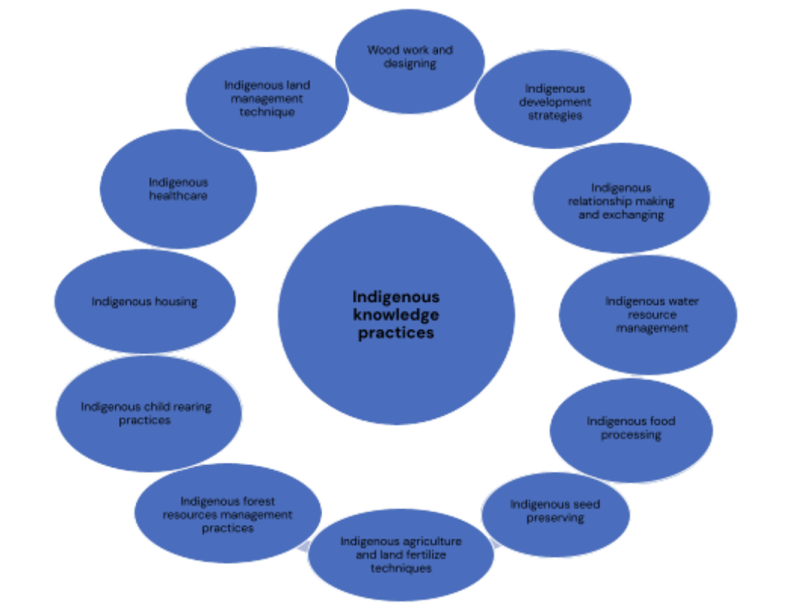
By nature, Indigenous Education is known as the traditional cum situational knowledge. It is considered traditional because it is passed down from generation to generation through various means, such as verbal instruction, trial and error, and hands-on experience, achieved by being deeply involved in the natural atmosphere or situation. Indigenous knowledge is grown and nurtured in a setting that is based on informal learning that flows spontaneously from community life in which people are not outsiders or impartial observers but a learning which is deeply embedded and embodied in the sense where emotion, intuition, and sense of place and nature play the most vital role in imparting unique strategies which assist in maintaining and sustaining the lives of the community. This traditional approach of knowing creates a unique pedagogical content, i.e., ‘indigenous pedagogy’, which is supported by the community and quite different from the conventional hierarchical model. So, these indigenous knowledge practices help to make our educational process more joyful and meaningful while enriching our curriculum content. If we want to transform educational theory into more creative, prolific practice and experience, we must bank on such a unique place-based alternative line of pedagogy as prevalent in tribal communities. Here we would like to locate how such a vibrant learning process operates in the Santhal community, which manages all dimensions of their lives in an integrated manner. This creates the conception of ‘living classroom’ embedded with traditional food collection, constructing building, and so on, that taken together compose an inclusive, natural, and innovative way of doing things or ‘talim’. So the story of indigenous pedagogy of the Santhal community is not artificial engineering or manipulative in a modern sense, but it reveals non- competitive, yet resilient ways of life and survival because it is essentially a collaborative exercise in which experiments derive from the core experience of living amidst nature. Hence, indigenous pedagogy is at the centre of their lives, and vocations like agriculture, animal husbandry, indigenous health care, traditional healing, indigenous fishing, nature study, land resource management, collection of natural resources from the forest, and so on. Thus Santhal community learns through trial and error, observing the natural facts through introspection, and even observes the natural phenomena for a long time to understand and interpret the ground reality through deep personal involvement.DOI:
https://doi.org/10.63942/brjssh.v5.i1.p45.49932Keywords:
environment, Environmental Sustainability., Indigenous Knowledge, Knowledge, SustainabilityIntroduction audio
A spoken introduction to this research.
Research ID
Universal Unique Research ID
e05775b1-09d2-4d5b-8410-1a5c86a3cd67Figures
Select a figure to view the full image.

References
Baily, F. G. (1960). Tribe, caste, and nation: A study of political activity and political change in highland Orissa. Oxford University Press.
Basant, R. (1990). Documentation of indigenous knowledge in Gujarat agriculture: A note. In Proceedings of the International Workshop on Generation and Diffusion (p. Xx). Indian Society of Agronomy.
Biggs, S. D., & Clay, E. (1980, March). Source of innovation in agricultural technology [Paper presentation]. Development Studies Association Workshop on Science and Technology, Oxford, UK.
Bisht, I. S., & Bhatt, K. C. (2001, February 27 - March 1). Indigenous Technical Knowledge (ITK): Principles and applications [Conference presentation]. Orientation Training under NATP, National Bureau of Plant Genetic Resources, New Delhi, India.
Charyulu, A. S. (2001). Dissemination of indigenous knowledge: A way to sustainable agriculture. National Institute of Agricultural Extension Management (MANAGE).
Chittiraichelvan, R., & Raman, K. V. (1991). Indigenous knowledge of farmers: Its use in extension strategies for rainfed agriculture. In Technology for minimising risk in rainfed agriculture (pp. 185–200). Indian Society of Extension Education.
Choudhury, R. P., & De, D. (1993, November 28 - December 3). Farmers' rationality in their innovations [Paper presentation]. Congress on Traditional Sciences and Technologies of India, IIT, Bombay, India.
Das Gupta, D. (2003, November 27-29). Policy initiatives for sustainable development in agriculture [Presidential address]. National Symposium on Crop Production under Changing Environment, Mohanpur, Nadia, West Bengal, India.
Dayakar, B. (1993, November 28 - December 3). Indigenous knowledge of dryland farmers in Anantapur Dist (AP) [Paper presentation]. Congress on Traditional Sciences and Technologies of India, IIT, Bombay, India.
Flavier, J. M. (1995). The regional programme for the promotion of indigenous knowledge in Asia. In D. M. Warren, L. J. Slikkerveer, & D. Brokensha (Eds.), The cultural dimension of development: Indigenous knowledge systems (pp. 479–487). Intermediate Technology Publications.
Gope, L., Singh, B., & Singh, C. K. (2017). Identification of indigenous knowledge components for sustainable development among the Santhal community. American Journal of Educational Research, 5(8), 887–893. https://doi.org/10.12691/education-5-8-8
Gourlay, S. (2004). The critical analysis of Nonaka’s model of knowledge dynamics. Electronic Journal of Knowledge Management, 2(1), 25-32.
Grenier, L. (1998). Working with indigenous knowledge: A guide for researchers. International Development Research Centre.
Gupta, A. K., & Patel, K. K. (1993). Survey of innovations for sustainable development: Do methods matter? Indigenous Knowledge and Development Monitor, 1(2).
Hare, W. L. (1990). Ecologically sustainable development. Australian Conservation Foundation.
Haskell, P. T., Beacock, T., & Wortley, P. J. (1981). World-wide socio-economic constraints to crop production. In Proceedings of the IX International Congress on Plant Protection (pp. 39–41).
Heverkort, B. (1995). Agricultural development with a focus on local resources: ILEIA's view on indigenous knowledge. In D. M. Warren, L. J. Slikkerveer, & D. Brokensha (Eds.), The cultural dimension of development: Indigenous knowledge systems (pp. 453–457). Intermediate Technology Publications.
Johnson, M. (Ed.). (1992). Lore: Capturing traditional environmental knowledge. Dene Cultural Institute/International Development Research Centre.
Kjell, O. N. E. (2011). Sustainable well-being: A potential synergy between sustainability and well-being research. Review of General Psychology, 15(3), 255–266. https://doi.org/10.1037/a0024920
Krishan, C. (1997). [Chapter title unknown]. In G. Sen (Ed.), Indigenous vision: Peoples of India, attitudes to the environment. Sage Publications & India International Centre.
Mallick, A. (2017). Santal women and the rebellion of 1855 in colonial India. Indian Journal of Gender Studies, 2(1), 11–23. https://doi.org/10.1177/0971521516687508
McCall, M. K. (1995). Indigenous technical knowledge in farming systems of eastern Africa: A bibliography (Bibliographies in Technology and Social Change No. 9). Iowa State University, Technology and Social Change Program.
Odhiambo, T. R. (1990). You cannot fix indigenous knowledge. ILEIA Newsletter, 6(2), 7-9.
Padaria, R. N., Singh, B., & Kumar, D. (2003a). Quantification of indigenous knowledge. In Training course on Indigenous Knowledge System for agriculture. Centre of Advanced Studies, Division of Agricultural Extension, IARI.
Padaria, R. N., Singh, B., & Kumar, S. (2003b). Indigenous knowledge and intellectual property rights. In Training manual on IKS for agriculture. IARI.
Paul, S., & Ramanathan, A. (2002). Conservation of rural bio-diversity through indigenous knowledge. Kurukshetra, 50(3).
Posey, D. A., & Dutfield, G. (1997). Indigenous people and sustainability. International Books.
Rahaman, C. H., & Karmakar, S. (2015). Ethnomedicine of Santal tribe living around Susunia hill of Bankura district, West Bengal, India: The qualitative approach. Journal of Applied Pharmaceutical Science, 5(2), 101–110. https://doi.org/10.7324/JAPS.2015.50216
Rajasekaran, B. (1993). A framework for incorporating indigenous knowledge systems into agricultural research, extension, and NGOs for sustainable agricultural development (Technology and Social Change Program, No. 21). Iowa State University.
Saha, A. (2006). Indigenous knowledge of dairy farming in Birbhum district of West Bengal, India: An exploratory study [Unpublished doctoral dissertation]. Visva-Bharati University.
Saha, A., Mukhopadhyay, S. B., & Das Gupta, D. (2006). Validation of indigenous knowledge in livestock health care system. Indian Journal of Extension Science.
Schaller, N. (1990). Low-input sustainable agriculture. In 1990 Yearbook of Agriculture: Americans in agriculture, portraits of diversity (pp. 216-219). U.S. Department of Agriculture.
Talwar, S., & Singh, Y. P. (1993). In search of wisdom among the farmers of arid agriculture: Documentation and analysis. In Proceedings of National Seminar on Indigenous Technologies for Sustainable Agriculture. IARI.
Ulluwishewa, R. (1993). Indigenous knowledge, national IK resource centres and sustainable development. Indigenous Knowledge and Development Monitor, 1(3), 11-13.
United Nations. (n.d.). Millennium Development Goals. Retrieved August 23, 2011, from http://www.un.org/millenniumgoals/
United Nations General Assembly. (2015, October 21). Transforming our world: The 2030 agenda for sustainable development (A/RES/70/1). https://sdgs.un.org/2030agenda
Copyright & reuse
© 2025 Dr. Laxmiram Gope, Sujit Kuiry, Shaktipada Mahato, Dr. Priyanka Karunamay. Authors retain copyright in their work. Reuse is permitted under Creative Commons Attribution 4.0 when the authors and original publication are credited.
License terms · Copyright policy
Disclaimer
The claims in this article belong to its authors and do not necessarily reflect the views of their institutions, Boston Research Journals, editors or reviewers. Publication does not constitute endorsement of a product or manufacturer’s claim.
Published
Issue
License
Copyright (c) 2024 Boston Research Journal of Social Sciences & Humanities

This work is licensed under a Creative Commons Attribution 4.0 International License.
Publication record
- Accepted
- 2025-03-29
- Published
- 2025-04-15
- Pages in issue
- 45 - 60
- Online ISSN
- 2834-4863
- Print ISSN
- 2834-4855
Peer reviewed research
Review by at least two independent experts under a double-blind process.
Peer review process ↗Copyright & access
🟢 Open Access | Creative Commons Attribution 4.0 International License (CC BY 4.0)
View license terms ↗Preservation & archival

Long-term preservation with BRJ Cloud.
View archival policy ↗Published by BRJ
Compiled and published in the United States of America.
About Boston Research Journals ↗Share this research